
Strait of Hormuz
There are places on the map that look small… almost insignificant at first glance.
And then there are places like the Strait of Hormuz, a narrow strip of water that silently holds the power to shake global economies.
It’s not dramatic in the way we imagine power to be. No loud announcements. No constant headlines (until something goes wrong). But this one passage, just about 33 km wide at its narrowest point, carries a weight that most of us don’t even realize in our everyday lives.
Because while you’re filling petrol, ordering something online, or even just going about your day, a significant part of that invisible chain passes through this one route.
🌍 Why the Strait of Hormuz Matters So Much
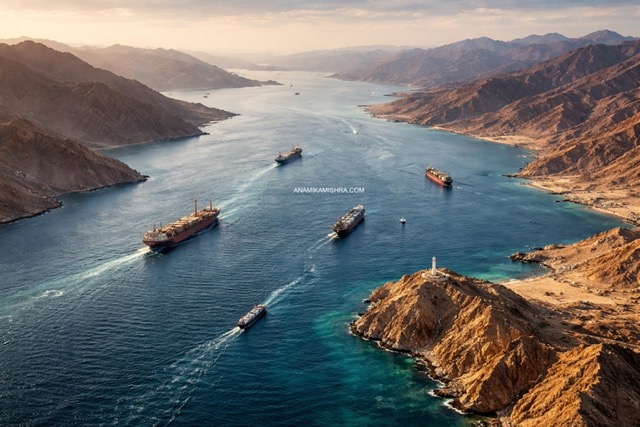
The Strait of Hormuz connects the Persian Gulf to the Gulf of Oman, and eventually to the open ocean. It’s bordered by countries like Iran to the north and Oman and the United Arab Emirates to the south.
But geography is just the beginning.
What truly makes it powerful is this:
Nearly 20–30% of the world’s oil passes through this narrow channel.
Yes, almost one-third of global oil trade depends on ships crossing this exact stretch.
Countries like Saudi Arabia, Iraq, Kuwait, and the UAE rely on this route to export oil to the rest of the world.
Which means if something disrupts the Strait of Hormuz, even temporarily, the effects ripple globally:
- Fuel prices spike
- Supply chains get disturbed
- Markets react instantly
It’s a reminder that sometimes, the most powerful things in the world aren’t visible… they’re logistical.
⚖️ A Place of Constant Tension
Now here’s where it gets even more intense.
The Strait of Hormuz isn’t just important, it’s sensitive.
For years, it has been at the center of geopolitical tension, especially involving Iran and Western powers like the United States.
There have been moments in history where:
- Tankers were att*ck*d
- Ships were se*zed
- M*l*tary presence increased dramatically
And every time something like this happens, the world pays attention.
Because it’s not just about one country or one conflict, it’s about the flow of energy that powers entire nations.
Even the threat of blocking the strait can cause global panic.
Let that sink in.
🚢 How Does Traffic Even Work Here?
You’d think something this important would be wide and easy to navigate, but it’s actually quite the opposite.
The shipping lanes in the Strait of Hormuz are:
- Only about 2 miles wide in each direction
- Carefully controlled and monitored
- Extremely busy with large oil tankers
This means precision is everything. One wrong move, one disruption, and the consequences aren’t just local, they’re global.
🌊 The Invisible Impact on Your Life
Here’s the interesting part: most people have never seen the Strait of Hormuz, and yet, it affects their daily lives more than they realize.
- Rising petrol prices? This route plays a role
- Inflation in goods? Transport costs are connected
- Global economic shifts? Often linked to oil supply
It’s a quiet reminder that the world is deeply interconnected.
A narrow waterway thousands of kilometers away can influence how much you pay for fuel, groceries, or even travel.
The Strait of Hormuz is more than just a geographical feature. It’s a global pressure point.
It teaches us something deeper too, that power doesn’t always come from size or visibility. Sometimes, it comes from position. From being at the exact place where everything passes through.
In a way, it’s almost symbolic.
Just like in life, where certain moments, decisions, or even people become “passages” that everything flows through. Small on the surface, but incredibly impactful beneath.
And maybe that’s why places like this fascinate me. Because they’re not just about maps or politics, they’re about connection, flow, and the invisible threads that tie the world together.
If you enjoy reading about powerful, lesser-talked-about topics like this, let me know. There’s a whole world of stories hidden in places we often overlook. 🌍✨